Once a year, Extreme Sports Scuba deliberately destroys the visibility at Indian Creek, hides stuffed animals underwater, and sends a group of certified scuba divers out to find them.
We’ve been doing this for a very long time.
It makes perfect sense to us.
On June 14, approximately 18 divers gathered at Indian Creek Campground on Beaver Lake for the 2026 Extreme Sports Scuba Safari Hunt. Ten stuffed animals were waiting to be hidden somewhere beneath the surface, more than $2,000 in prizes were up for grabs, and a fundraiser raffle would benefit Newton & McDonald County Christmas for Kids.
The rules were simple.
Mostly.
An Extreme Sports Scuba Tradition
The Safari Hunt has been an Extreme Sports Scuba tradition for longer than some of our divers have been certified.
Originally, the targets were little stuffed dive gorillas. Eventually, those became impossible to find, so we expanded our definition of “safari animal.”
Considerably.
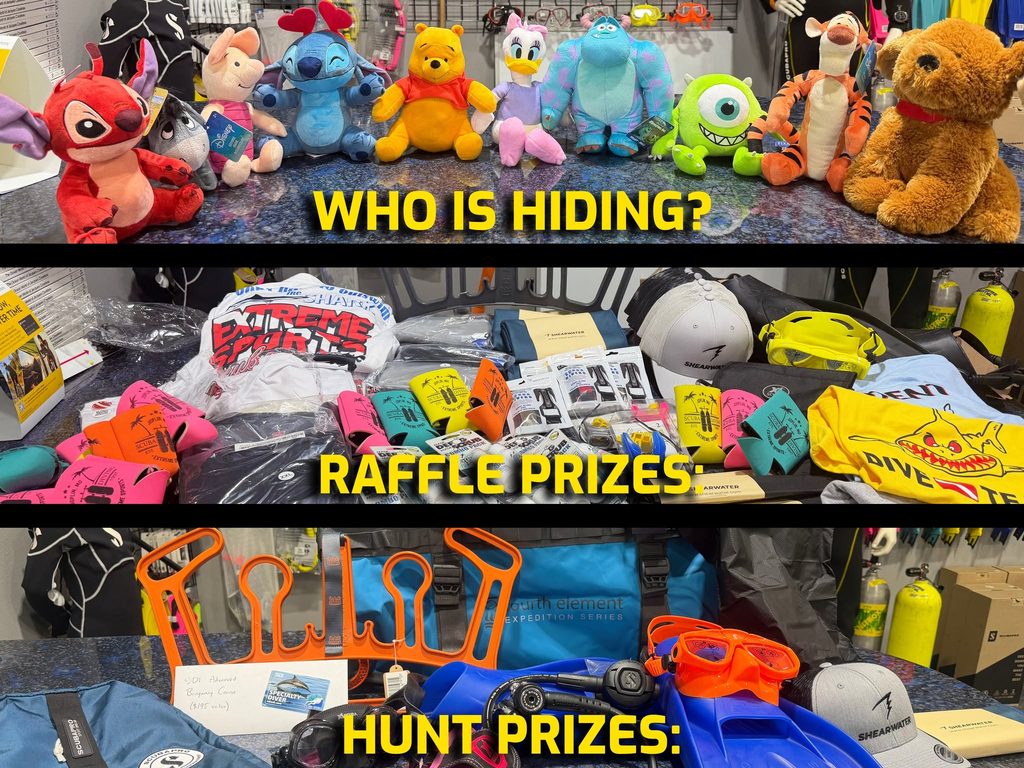
This year’s collection included Winnie the Pooh, Piglet, Daisy Duck, Sulley, Mike Wazowski, Tigger, Stitch and a few other characters that probably never expected scuba diving to be part of their future.
Apparently, the safari has become fairly inclusive.
The concept, however, has remained the same: hide the animals in the dive park at Indian Creek, send certified divers out to search for them, and reward the successful hunters with dive gear and prizes.
The event is completely free to enter. The only requirements are proof of scuba certification, a signed waiver, and a willingness to spend up to 45 minutes searching Beaver Lake for a stuffed animal you could have found much more easily at a store.
But, where’s the fun in that?
First, Make Sure Nobody Can See
Indian Creek is familiar territory for Extreme Sports Scuba. It’s where we conduct many of our local lake dives and where countless ESS students have completed their checkout dives.
For the Safari Hunt, however, knowing the dive site only gets you so far.
About 30 minutes to an hour before the official start, everyone has to get out of the water.
That’s when the sabotage begins.
This year, Doug, Jared, and Bentley headed out to hide ten numbered stuffed animals within the designated hunt area, generally between about 20 and 35 feet.
They also stirred up the bottom.
On purpose.
Visibility at Indian Creek can already be limited. For the Safari Hunt, we improve upon that by deliberately making it worse.
It prevents anyone from seeing where the animals are being hidden, but it also turns the hunt into a legitimate underwater search and navigation exercise.
And sometimes the visibility gets really bad.
In a previous Safari Hunt, one diver managed to run headfirst into the bottom because she couldn’t see it approaching. After attempting to figure out exactly where she was, she discovered the answer by standing up.
She was in approximately four feet of water.
No names are necessary.
Moving on.
Ready, Set… Find Something
Before the hunt began, Jared went through the official rules with everyone.
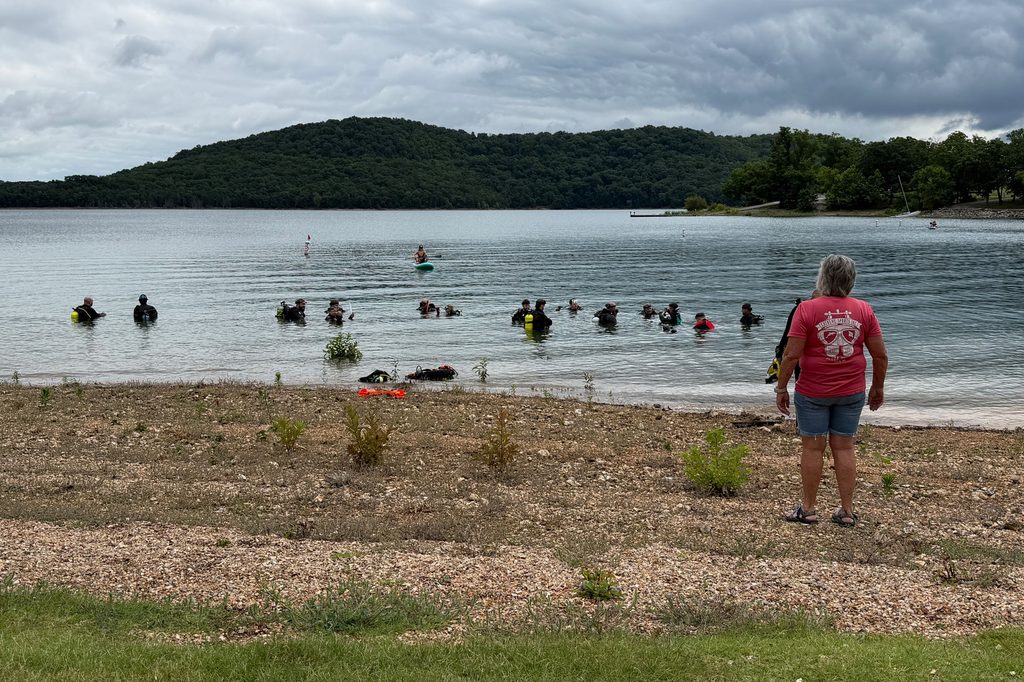
Divers had to use the buddy system unless properly equipped and certified for solo diving. Dive propulsion vehicles weren’t allowed. Each diver could retrieve only one animal, and everyone had a maximum of 45 minutes or until reaching 700 PSI, whichever came first.
Everyone also had to be geared up and in the water before the start. No wandering down to the shoreline at 1:03 wondering whether everyone had left without you.
Surface safety divers were positioned in the water, with additional support on land. Divers were expected to give an OK signal when they surfaced.
And then there was the official end-of-hunt signal:
A duck call powered by a scuba tank.
At one point, the duck call wound up on shore in the hands of someone who couldn’t actually operate it because its required scuba tank was in the water.
Fortunately, that became irrelevant.
We never needed it.
At 1:00 p.m., the hunt began, and approximately 18 divers took off in search of only ten animals.
Those aren’t particularly favorable odds.
Finders, Keepers… Sort Of
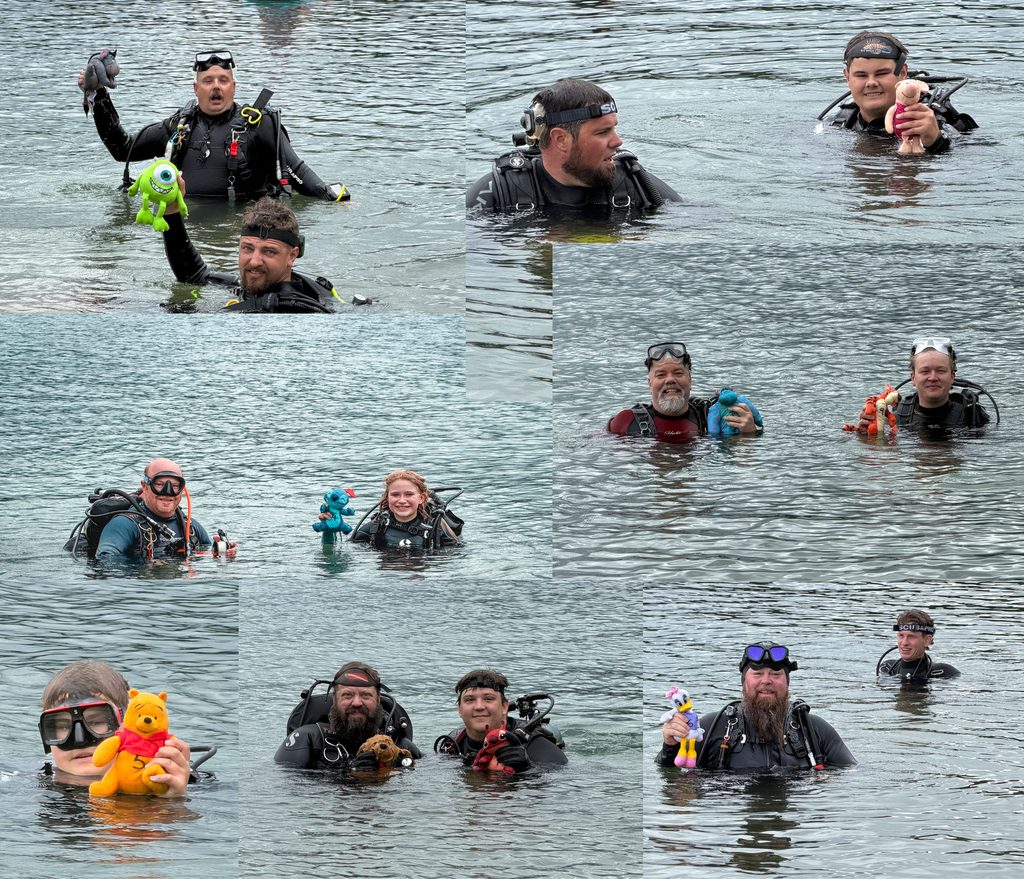
Finding an animal didn’t mean the diver got to take Winnie the Pooh home.
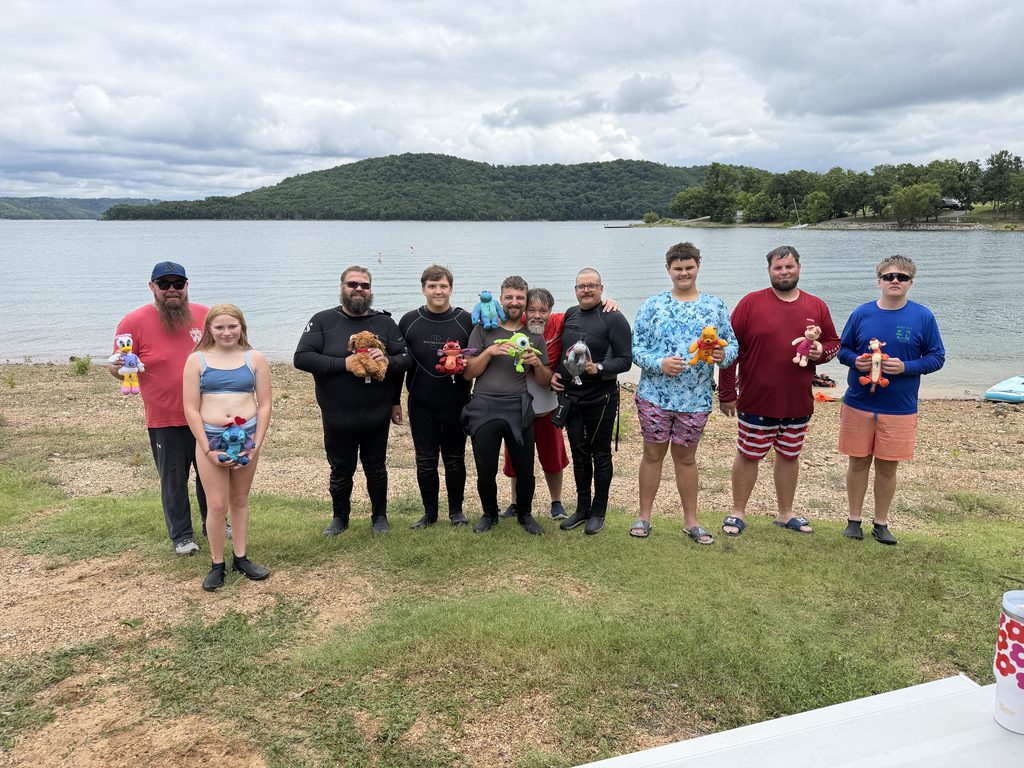
Each stuffed animal carried a number. Once a diver surfaced with one, the number was recorded and the successful hunter posed for the obligatory photograph with the animal and dive buddy.
At which point names also became unnecessary.
If you came out of Beaver Lake carrying Winnie the Pooh, congratulations. For the foreseeable future, your name was Winnie the Pooh.
Piglet? Piglet.
Tigger? Tigger.
Stitch? You get the idea.
It was much more entertaining that way.
Then everyone waited to see whether the remaining animals would be recovered.
A few divers surfaced empty-handed and, while they still had the time and air to continue safely, were encouraged to head back out and keep looking. Nobody was given an exact location, but a vague suggestion about where they might want to search may have occurred.
Most came back with an animal.
There were also reports of divers swimming right past animals without seeing them, which is exactly what you’d expect when someone has intentionally turned the bottom of Beaver Lake into chocolate milk.
For one of the first times in recent memory, though, the hunt ended with a clean sweep:
All ten of the 2026 animals were recovered.
Even better, nobody accidentally unearthed a stuffed animal left behind from a previous Safari Hunt.
Yes, that has happened. Many times.
Apparently, there are years when the local aquatic ecosystem includes a forgotten stuffed “gorilla.”
Ten Animals, Ten Hunt Prizes
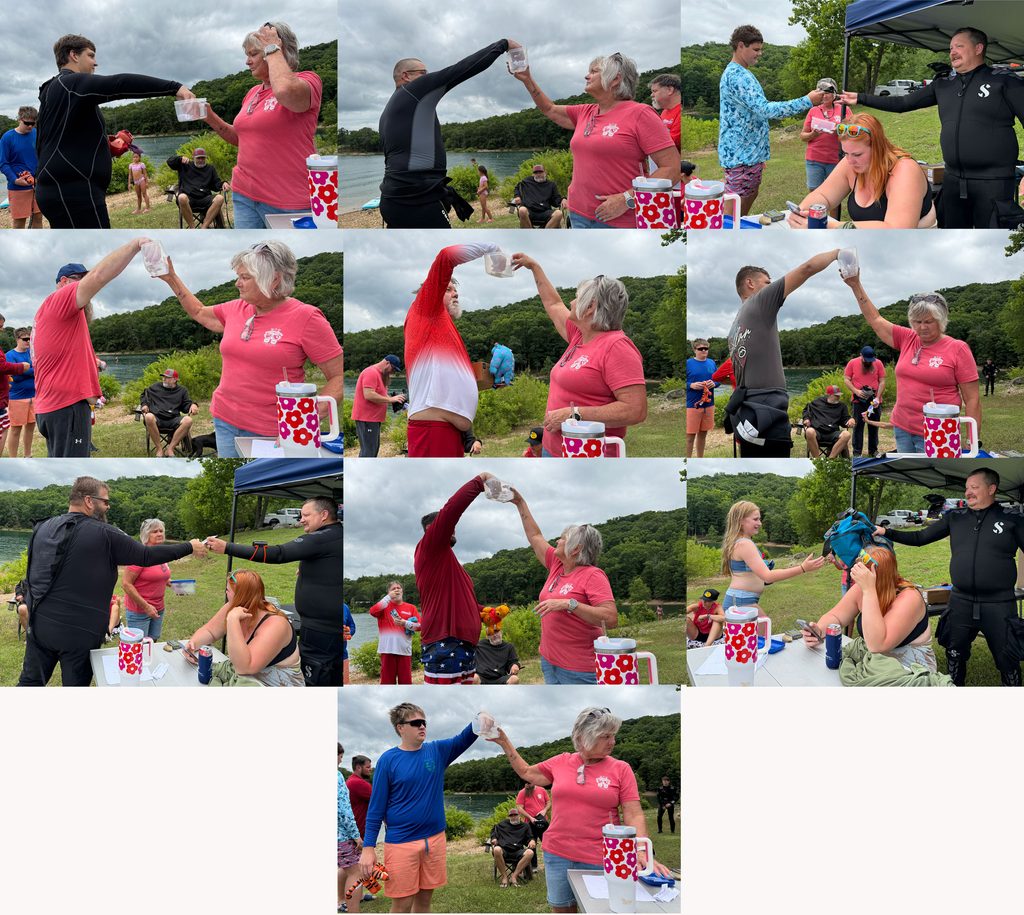
Once the diving portion ended, everyone had time to get out of the water, tear down gear and gather for a group photo before moving on to the prizes.
Finding one of the ten animals guaranteed a diver a prize.
The number attached to the animal determined the order in which the successful hunters drew from a bowl containing the ten designated Safari Hunt prizes.
Animal #1 went first, followed by #2 and so on.
And nobody knew exactly which prize they were going to pull.
There may also have been a little attempted bartering once people realized what everyone else had won.
Friendly competition is still competition.
With fewer animals than participating divers, though, finding one underwater was the hard part.
And there was plenty worth hunting for.
More than $2,000 in prizes were available between the Safari Hunt and fundraiser raffle, with donations and support from companies throughout the dive industry. Prizes included a Scubapro MK11/S270 regulator, a Fourth Element Expedition Series dry duffel bag, an XS Scuba mask, an SDI Advanced Buoyancy course, a C-Monsta custom dive gear hanger, line cutters, regulator mouthpieces, dive accessories, swag and more.
Contributors included: Extreme Sports Scuba, Scubapro, Fourth Element, XS Scuba, 500psi, Ocean Technology Systems, EZZY CUT, SeaCure, Trident Dive Equipment, Shearwater Research, SDI/TDI, and C-Monsta.
Not bad for finding Winnie the Pooh at the bottom of Beaver Lake.
Diving for Christmas for Kids
The Safari Hunt itself has no entry fee.
Alongside it, however, Extreme Sports Scuba holds a raffle benefiting Newton (& McDonald) County Christmas for Kids, with tickets sold for $2 each or three for $5.
The connection between the organization and Extreme Sports Scuba goes well beyond choosing a charity for an annual fundraiser.
ESS owner Deb Weston has long been involved with Christmas for Kids, as was her late husband. Other members of the Extreme Sports Scuba community have been involved with the organization as well. Over the years, the two groups have become intertwined through many of the same people volunteering their time and supporting their communities.
So, while the Safari Hunt gives divers an excuse to spend an afternoon underwater chasing stuffed animals, the raffle gives the day a purpose beyond diving and prizes. Money raised helps Christmas for Kids provide support to children in Newton and McDonald counties during the holiday season.
And divers get the opportunity to win even more stuff.
Everybody wins.
Well, theoretically.
About That Raffle…
The raffle prizes were separate from the ten Safari Hunt prizes.
Tickets went into a fishbowl, names were drawn, prizes were handed out and everything operated exactly as a perfectly legitimate fundraiser raffle should.
There was just one small problem.
The same people seemed to keep winning.
Again.
And again.
Eventually, questions were raised.
Had the fishbowl been rigged?
Were certain tickets somehow magnetized?
Had somebody developed a highly specialized form of raffle-ticket buoyancy control?
No evidence of wrongdoing was uncovered.
That did not stop the accusations.
To be clear, the accusations were coming primarily from people who weren’t currently winning.
Make of that what you will. We are family after all. A little heckle here and there never hurt anyone.
More Than a Scavenger Hunt
It would be easy to describe the Safari Hunt as an underwater scavenger hunt, and technically, that’s exactly what it is.
But after so many years, it has become one of those slightly strange traditions that makes perfect sense to the people involved.
Indian Creek isn’t a once-a-year destination for Extreme Sports Scuba. It’s where many of our divers complete their first checkout dives. It’s where classes happen, skills get practiced and new divers begin gaining experience outside the pool.
Then, once a year, we take that familiar dive site, stir the bottom into oblivion and hide stuffed animals in it.
The event puts search patterns, navigation, buddy awareness, buoyancy, and air management to use without making any of it feel particularly like training. There are junior divers hunting alongside adults, experienced divers swimming past stuffed animals they swear weren’t there, safety divers watching from the surface and people on shore waiting to see what—or who—comes up next.
This year, the weather was overcast and cool enough for shorts and a lightweight sweatshirt topside. Most divers wanted at least a 3 mm wetsuit in the water, particularly around and below the thermocline near 20 feet.
Once the last animal surfaced, the competition gave way to tearing down gear, comparing stories, taking pictures, and hanging around before the prize drawings. Some divers called it a day afterward.
Others went diving again.
Because apparently 45 minutes blindly searching for stuffed animals wasn’t enough time underwater.
Until Next Year’s Hunt
The 2026 Safari Hunt managed something we don’t see every year:
All ten animals came home.
No animals were left behind for next year’s divers to unexpectedly discover. No long-lost Safari Hunt relics from previous years resurfaced. The duck call never had to announce the end of the hunt.
Ten divers found animals. Ten Hunt prizes went home with their winners. More prizes were awarded through the Christmas for Kids raffle, and a familiar group of divers spent another afternoon carrying on an Extreme Sports Scuba tradition that dates back well over a decade.
There was competition.
There was questionable visibility.
There were stuffed animals where stuffed animals generally shouldn’t be.
People temporarily lost their given names and became Piglet, Tigger and Winnie the Pooh.
And there remains lingering suspicion surrounding the integrity of a certain fishbowl.
Sounds about right for the Extreme Sports Scuba Safari Hunt.