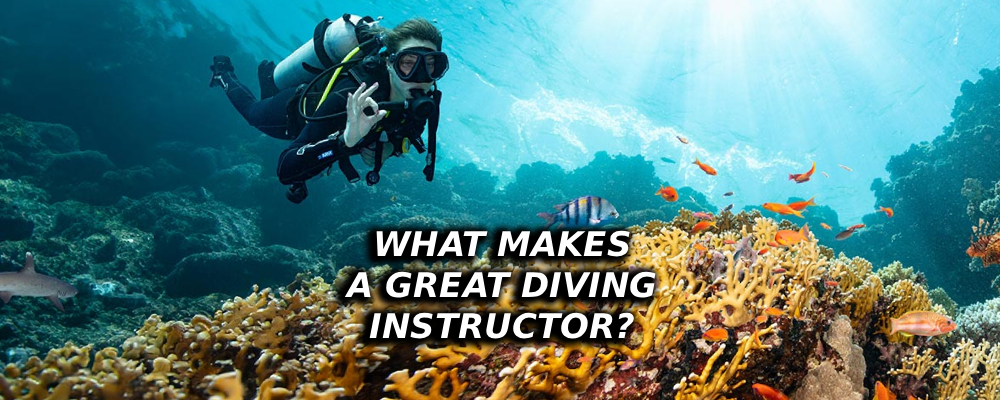
What Makes a GREAT Diving Instructor?

It's more than skills

A great diving instructor is about much more than teaching skills and handing someone a certification card. A certification tells you that a diver has completed the requirements of a course. It does not necessarily tell you that they are confident, comfortable, or truly understand what they are doing underwater.

That is where a great instructor makes the difference.

Share on facebook
Facebook
Share on reddit
Reddit
Share on print
Print
Share on email
Email

Professionalism Matters

Being a professional instructor means treating every student, every class, and every dive with the level of importance they deserve.

Be prepared. Be on time. Know your equipment. Know your training materials. Know the dive site. Know what conditions your students may encounter.

Most importantly, take your responsibility seriously. Students are trusting you to teach them skills that could one day make a significant difference in their safety underwater. Read that again.

Know Your Stuff, and Know What You Don't Know

A good instructor should have a strong understanding of the information they are teaching. But being a good instructor does not mean pretending to know everything.

If a student asks a question and you do not know the answer, say so.

There is absolutely nothing wrong with telling a student, “I don’t know, but I’ll find out.”

In fact, that is often a better answer than giving them information that is incomplete or incorrect. A professional instructor should be comfortable continuing the conversation, researching the answer, and getting the student the correct information.

The goal is not to look like you know everything. The goal is to make sure your students are getting the right information.

Why These Skills Matter on Every Dive

Even when diving with a trusted buddy or group, separation can happen. Visibility changes. Currents shift. Equipment fails. Stress affects people differently. In those moments, your safety depends on your own awareness and abilities.

Divers who lack self-awareness often miss early warning signs and react late. Divers who lack self-sufficiency may hesitate or rely on others when immediate action is required. Developing these skills makes you a better buddy, a safer diver, and a more confident explorer.

Self-awareness and self-sufficiency also make diving more enjoyable. When you are not constantly uncertain or dependent, dives feel smoother, calmer, and more controlled. You are free to enjoy the environment while still maintaining a strong safety margin.

An Instructor Should Always Be Learning

Becoming an instructor should never be the end of your education. Great instructors continue diving. They continue taking courses. They learn new equipment, explore new environments, stay current with industry practices, and continue developing their own skills.

If we expect our students to continue learning and improving as divers, we should be willing to do the same. The best instructors are still students themselves.

Don't Just Teach the Skill. Teach the Diver.

This is one of the biggest differences between simply completing a course and actually becoming a diver.

It is easy to look at a checklist and think, “They did the skill. Move on.”

But what happens when the student leaves the class?

Do they understand why they performed the skill? Are they comfortable doing it? Can they recognize when they need to use it? Can they perform it without feeling overwhelmed?

And most importantly, are they actually enjoying diving?

One of the things I care about most when teaching is buoyancy. I don’t want a student to simply demonstrate that they can hover for a few seconds because the instructor told them to. I want them to understand buoyancy well enough that it becomes natural. That takes time.

Let the Student Tell You When They Are Ready

My goal is not to get a student through a list of skills as quickly as possible. I want the student to reach a point where they know they have mastered the skill.

There is a big difference between an instructor saying, “You’re good, let’s move on,” and a student saying, “I understand this. I know what I’m doing. I could perform this again if I needed to.”

That confidence is what we should be building. A certification card should be the result of learning, not the goal of learning. Too many instructors focus on getting students through a course as quickly as possible. Skills are checked off, paperwork is completed, and a card is handed over.

Technically, the course is finished.

But is the diver ready?

That is the question we should be asking.

We Are Better Than the Minimum

Training standards exist for a reason. They establish a baseline for what a student must demonstrate to earn a certification. But the minimum standard should not always be the goal.

If a student needs more time, give them more time. If they need another explanation, explain it differently. If they need to repeat a skill five times instead of once, do it.

Our job is not to produce divers who can barely meet the requirements. Our job is to produce divers who are comfortable, capable, knowledgeable, and excited to go diving.

Leave a Comment

Your email address will not be published. Required fields are marked *